
If you've ever sat down to do your bookkeeping and had no idea where to even start, you're in good company. Most boutique owners feel exactly the same way, and it's not because they're bad at math. It's because nobody ever handed them a clear path to follow. You've been trying to build a system from scratch, by yourself, with no idea what order things are supposed to happen in. That's exhausting. So you avoid it. You put it off. And the pile just keeps getting bigger.
Here's the good news. There IS a clear way to learn bookkeeping, and it doesn't require a degree in accounting or hours of confusing YouTube tutorials. It just requires the right path, broken into manageable stages, so you can tackle one thing at a time instead of trying to figure it all out at once.
This post may contain affiliate links, which means I may earn a small commission if you make a purchase through them — at no extra cost to you. I only share products and tools I truly love and recommend!
Prefer to listen instead of read? Listen to the related podcast episode here, or find it on your favorite platform:
Why Learning Bookkeeping Feels So Overwhelming
One of the most common phrases I hear from boutique owners is “I don't know what I don't know.” They don't know where to begin. They don't know what to ask. They don't even know what they SHOULDN'T do. And that's not a knock on them. Bookkeeping isn't something that comes naturally. It's a learned skill, one I've spent the past 14 years building expertise in.
If you're feeling behind, it's not because you're incapable. It's because nobody's ever shown you the actual steps in order.
The Success Path: How to Learn Bookkeeping in 5 Stages
Inside Bookkeeping Made Simple for Boutiques, every member walks the same Success Path. It's already mapped out, which means you don't have to guess what to do first, second, or third. Here's what each stage actually accomplishes.
Stage 1: Setup
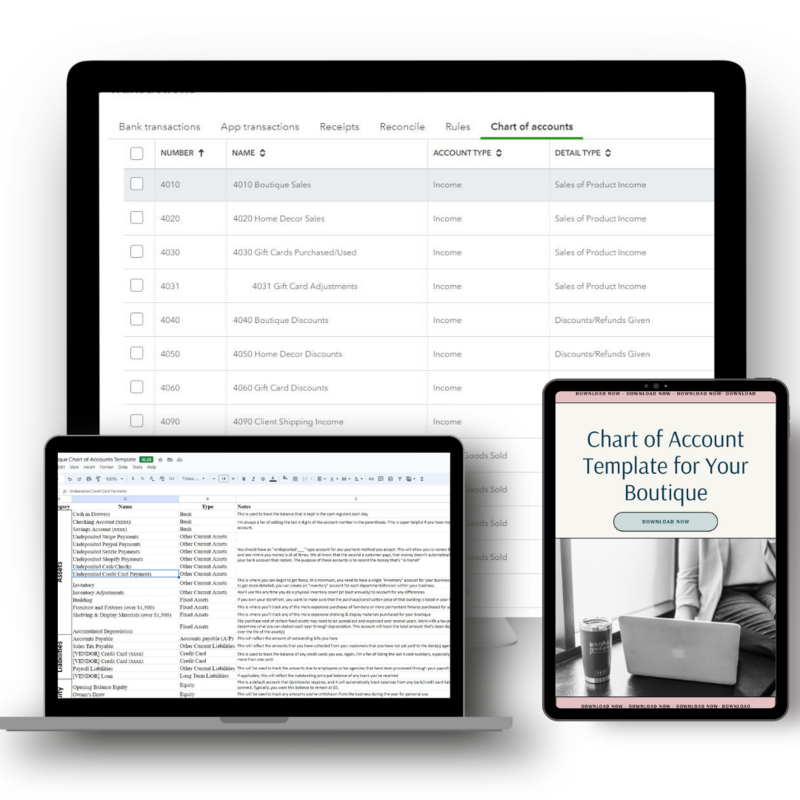
Most boutique owners come to me having either never opened QuickBooks, or having opened it, clicked around for a few minutes, panicked, and closed the laptop. QuickBooks wasn't built with a boutique in mind. It's generic enough to work for any business, which means if nobody shows you how to customize it for YOUR business, you end up with a chart of accounts that makes your financial reports confusing and messy.
By the end of this stage, you'll have a QuickBooks Online account built specifically for a boutique that sells product and runs sales through something like Shopify or Square. You won't be entering financial data yet. You'll just be laying a foundation that makes everything from this point forward easy to use and easy to understand.
Stage 2: Money Out
This stage covers the 7 different reasons money leaves your business account: expenses, inventory purchases, paying yourself, payroll, transfers, and more. Here's the part that trips up a lot of boutique owners. Not all of these get treated the same way in your bookkeeping. Some don't even show up on your Profit & Loss report the way you'd expect.
By the end of this stage, you'll know the difference between an expense, an asset, and a draw, and exactly how to record each one. That distinction matters at tax time too, since capturing your deductible expenses correctly helps lower your taxable income so you're not overpaying.
Stage 3: Money In
This is a big one, especially if you sell through Shopify. Here's what happens to almost every boutique owner before they learn this stage. A deposit hits their bank account, and they record the WHOLE thing as income. But that deposit isn't just sales. It's your gross sales, minus discounts, minus refunds, minus sales tax, minus processing fees, all mashed into one number.
By the end of this stage, your QuickBooks reports will match your sales reports directly from your point-of-sale system. You'll be recording the correct amount of income, not overstating it with sales tax you collected, and not understating it because of processing fees.
Stage 4: Reviewing (Reconciling)
This is the stage that's tempting to skip. I was working with a boutique owner earlier this year who was up against a time crunch, and she asked me point blank, “How important is it that I reconcile everything?” My answer was simple: very important.
Reconciling means matching what's in QuickBooks against your actual bank, credit card, and payment processor statements to make sure everything lines up. It catches mistakes, and it makes sure your payment processors are paying you every penny you're owed. Before you reconcile, your numbers might LOOK right. After you reconcile, you KNOW they're right.
Stage 5: Reporting
There's nothing left to DO at this stage. All the work is done. This is where you get to actually learn from it, by reading your three core financial statements: your Balance Sheet, your Income Statement (P&L), and your Statement of Cash Flows.
So many boutique owners avoid their financial reports entirely, or don't even have them. But those reports tell the whole story of your money. They show your profit margin, your overall profit after overhead, why your P&L doesn't match your bank account, what you owe in taxes, and what you can actually afford to pay yourself. By the end of this stage, you'll understand what each report is telling you, and you'll start making financial decisions with real confidence.
You Don't Have to Figure This Out Alone
If you've been wondering how to learn bookkeeping without spending months stuck in trial and error, this is exactly why the Success Path exists. Every stage is already built for a boutique like yours. You just have to walk it.
And if you've been hoping to get your bookkeeping sorted out before January forces you to figure it out, now is the time to take action. Enrollment for Bookkeeping Made Simple for Boutiques closes this Thursday night. This is your last chance to get boutique-specific bookkeeping support before the end of the year. Doors will likely reopen sometime in late January or early February.
Head to findingfreedomfinancial.com/membership to join before the doors close.

view + leave comments . . .